PS2 Specs: Every PlayStation 2 Model Compared
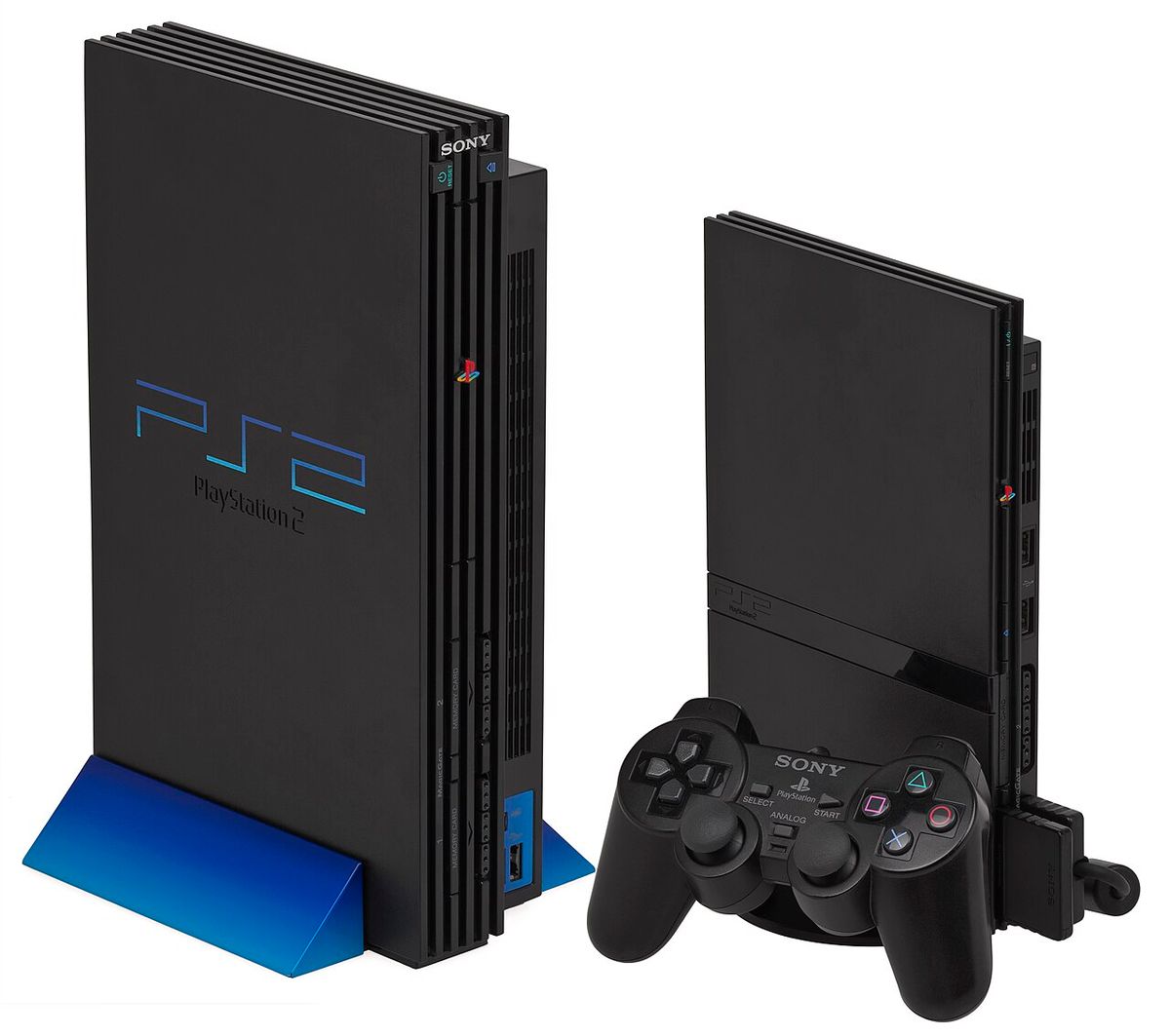
When the PlayStation 2 launched in March 2000 it was the most powerful games console ever sold — and one of the strangest pieces of silicon ever mass-produced. Instead of off-the-shelf parts, Sony built the machine around two custom chips with names designed to impress shareholders: the "Emotion Engine" CPU and the "Graphics Synthesizer" GPU. This guide breaks down the full PS2 specs in plain English, explains what each component actually did, and compares every hardware revision Sony released across the console's thirteen-year production run — from the Japan-only SCPH-10000 to the final SCPH-90000 Slim.
PS2 Specs at a Glance
| Component | Specification |
|---|---|
| CPU | "Emotion Engine" — custom 128-bit MIPS R5900 core at 294.912 MHz (299 MHz on later revisions) |
| Vector units | VPU0 + VPU1 — two dedicated floating-point processors for geometry, physics and animation |
| Floating-point power | 6.2 GFLOPS combined (CPU, FPU and vector units) |
| GPU | "Graphics Synthesizer" at 147.456 MHz — 4MB embedded DRAM, 16 parallel pixel engines, ~2.4 gigapixels/sec theoretical fill rate |
| System memory | 32MB RDRAM, dual-channel, ~3.2 GB/s bandwidth |
| Sound | SPU2 audio processor — 48 channels, 2MB dedicated sound RAM, Dolby Digital and DTS output over optical |
| I/O processor | Original PlayStation CPU (MIPS R3000A) — drives controllers, memory cards and the disc drive, and provides native PS1 backwards compatibility |
| Optical drive | 4× DVD-ROM / 24× CD-ROM — plays PS2 games, PS1 games, DVD video and audio CDs |
| Saves | 8MB memory cards (two slots) |
| Expansion | Fat models: rear expansion bay takes the Network Adaptor (ethernet/modem) plus a 3.5" IDE hard drive |
| Ports | 2× USB 1.1, i.Link (IEEE 1394/FireWire) on models before SCPH-50000, optical digital audio out, AV multi-out |
| Video output | Composite, S-Video, RGB SCART and component (YPbPr) — up to 1080i in the handful of games that support it |
| Controller | DualShock 2 — twin analogue sticks plus pressure-sensitive face buttons |
Inside the Hardware
The Emotion Engine
The Emotion Engine is the part Sony marketed hardest — the name was meant to suggest it could render realistic human emotion in characters. Underneath the branding it's a custom MIPS R5900 core running at 294.912 MHz, joined on the same die by two vector processing units (VPU0 and VPU1), an FPU, a 10-channel DMA controller and an MPEG-2 decoder called the IPU. The headline figure was 6.2 GFLOPS — roughly triple what Intel's fastest Pentium III of the day managed — and a theoretical 75 million polygons per second.
Real games never hit those numbers because the architecture was notoriously hard to program: VPU1 ran its own microcode in parallel with the CPU, so developers effectively had to write tiny programs for a second processor just to feed the graphics chip. Teams that mastered it produced stunning results — the leaps between ICO, God of War II and Shadow of the Colossus show what late-era mastery looked like.
The Graphics Synthesizer
The GS is a rasteriser, nothing more — it fills pixels, maps textures and applies lighting, while the vector units do the geometry work upstream. Its party trick was bandwidth: 4MB of DRAM embedded directly on the die connected by a 2,560-bit bus, giving it an internal bandwidth figure around 48 GB/s that humbled contemporary PC graphics cards. The trade-off was a fixed-function pipeline — no programmable shaders — which is why late-generation PS2 games can look flatter than their Xbox equivalents even though the raw fill rate was competitive.
32MB of Rdram — And a Whole PS1 Inside
System memory is 32MB of Rambus RDRAM on a dual-channel interface good for about 3.2 GB/s — fast, but tight enough that PS2 engines were built around constant streaming. The cleverest component is the I/O processor: it's literally the MIPS R3000A CPU from the original PlayStation. In normal use it handles the joypads, memory cards and disc I/O — but when you insert a PS1 disc it takes over entirely, which is why backwards compatibility on the PS2 is near-perfect. The console genuinely contains a PS1.
Every PS2 Model Compared
Sony revised the hardware constantly. Model numbers start with SCPH (Sony Computer Entertainment Hardware Peripheral) followed by a five-digit series number; the last digit is a region code — 0 Japan, 1 North America, 3 UK, 4 Europe — with letters like CB (charcoal black) or SS (satin silver) marking colour variants.
| Model series | Years | What changed |
|---|---|---|
| SCPH-10000 / 15000 / 18000 | 2000–01 | Japan-only launch consoles. PCMCIA slot instead of the later expansion bay; the earliest two needed a DVD player app installed on a memory card before they could play films. |
| SCPH-3000x – 3900x | 2000–03 | The worldwide "fat" PS2. Rear expansion bay accepts the Network Adaptor — ethernet or dial-up plus a 3.5" IDE hard drive. i.Link port up front for early LAN play. Early 3000x units are notorious for disc-read-error laser failures. |
| SCPH-500xx | 2003–04 | The refined fat model: quieter, more reliable laser, i.Link removed, built-in IR for the DVD remote, and progressive-scan DVD playback. Often considered the best fat revision. |
| SCPH-700xx "Slim" | 2004–05 | 75% smaller and under a kilogram, with a top-loading disc lid and ethernet built in — no adaptor needed for online play. External power brick; the HDD bay is gone for good. |
| SCPH-750xx | 2005–06 | Major cost reduction: Emotion Engine and Graphics Synthesizer merged onto a single chip. A small number of games have compatibility quirks on this revision. |
| SCPH-770xx | 2006–07 | Further shrink of the same design — lighter power supply and cosmetic tweaks, same performance. |
| SCPH-790xx | 2007–08 | EE, RDRAM, SPU2 and IOP combined into fewer packages; the motherboard shrinks again and the console gets lighter still. |
| SCPH-900xx | 2007–13 | The final revision: the power supply moves inside the case (no more brick) and production runs until the PS2 was discontinued in January 2013. |
Fat vs Slim — The Short Version
Every PS2 plays every PS2 game identically — the differences are in the ports and expansion. The fat model is the only one that officially takes a hard drive and the only later revision with i.Link; the Slim is quieter, smaller, has networking built in and its top-loading lid is kinder to ageing lasers. We cover the whole comparison — including which SCPH numbers to hunt for — in our dedicated PS2 Slim guide.
The Oddballs: PSX and the Bravia TV
Two official machines are PS2s without looking like it. The PSX (DESR-5000/7000, Japan, 2003) was a fat PS2 fused with a DVR — hard drive recorder, XMB-style interface, and the launchpad for the look the PS3 later adopted. The KDL-22PX300 (Europe, 2010) went further: a 22-inch Sony Bravia TV with a complete PS2 built into its base.
What the Numbers Actually Meant
On paper the PS2 looked outgunned quickly — the 2001 Xbox shipped with a 733 MHz Intel CPU and 64MB of RAM, over double the memory. But megahertz comparisons mislead: the PS2's vector units and the Graphics Synthesizer's enormous internal bandwidth let late-era developers pull off effects the spec sheet shouldn't allow. What the numbers genuinely never overcame was memory — 32MB was tight even in 2000, and it's the single biggest reason PS2 textures and open worlds look constrained next to Xbox rivals.
None of it mattered commercially. The PS2 sold over 155 million units, stayed in production for thirteen years across twelve model revisions, and assembled a library of nearly 4,000 games — still the largest of any console ever made.
Which Model Should You Buy Today?
For collectors and modders the fat SCPH-3900x or SCPH-500xx is the pick — the expansion bay fits modern IDE/SATA hard-drive adaptors for running a full game library. For most players a late Slim (SCPH-770xx or 900xx) is the practical choice: cheap, quiet, reliable and ethernet-ready out of the box. Avoid the earliest SCPH-3000x units unless they're cheap — the laser wear issue is real. Whichever you land on, our games archive and cheats library cover the whole catalogue.