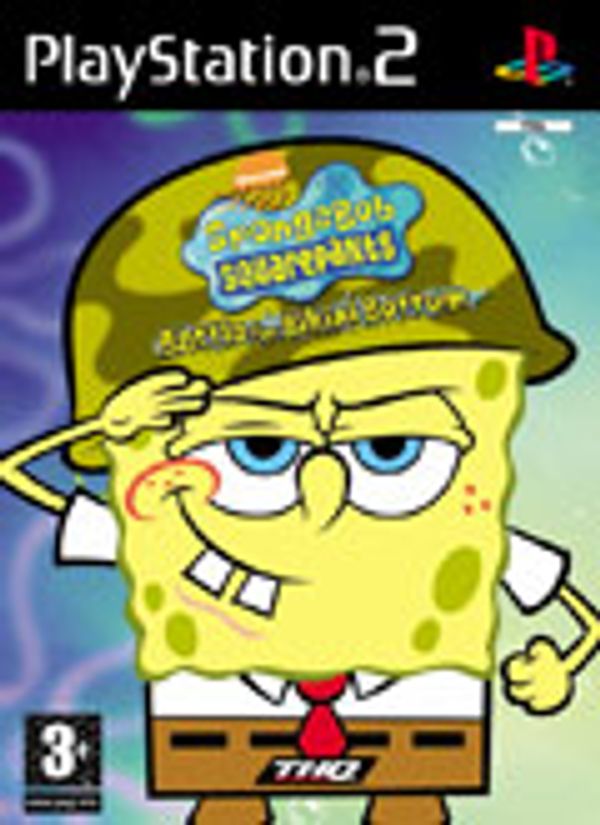
Spongebob Squarepants: Battle for Bikini Bottom
About Spongebob Squarepants: Battle for Bikini Bottom
From the archive
This is the original PS2Home fact sheet for Spongebob Squarepants: Battle for Bikini Bottom, preserved from the early-2000s archive. Details reflect the PAL release as catalogued at the time.
Official fact sheet
In an effort to cause the kind of global mayhem he has always dreamed of, the evil Plankton has set in motion his most diabolical plot ever to take over the world and the fate of Bikini Bottom has been put in the hands (or small tentacles) of three unsuspecting heroes. Put your platform skills to the ultimate test as SpongeBob, Patrick, or Sandy Cheeks with an array of insane new maneuvers and power-ups at your disposal. Explore a huge 3D world, encounter familiar friends, and finally put an end to Plankton’s evil scheme.
- Three playable characters: SpongeBob SquarePants, Patrick Star, or Sandy Cheeks – each with their own special moves and abilities.
- Crazy maneuvers like “Tongue Boarding,” “Underwear Bungee Jumping,” and the “Lasso Copter” along with insane power-ups like the “Guided Cruise Bubble” and “Bubble Bowl.”
- 10 huge 3D environments to explore including bonus levels, hidden items, and other secret rewards.
- Your favorite characters from the cartoon including special cameo appearances.
SpongeBob SquarePants: Battle for Bikini Bottom was Heavy Iron Studios’ 2003 3D action-platformer for PlayStation 2, published by THQ and based on Nickelodeon’s animated series. It was built as a traditional collect-and-platform adventure rather than a short licensed mini-game package, with three playable characters, ten sizeable worlds and a substantial list of optional objectives. The PAL version reached Britain on 28 November 2003. Its original reviews were mixed but broadly respectable, while a later cult following, active speedrunning scene and 2020 remake gave the game a much longer life than its contemporary scores suggested.
Story and setting
Plankton creates the Duplicatotron 3000 to manufacture an army of robots for his latest attempt to take over Bikini Bottom and steal the Krabby Patty formula. He makes the crucial mistake of leaving the machine set to “Don’t Obey”, allowing the robots to turn on him, seize the Chum Bucket and spread through the town. At the same time, SpongeBob and Patrick have been playing with toy robots and wishing that real ones would appear, giving Plankton an opportunity to blame the disaster on the pair’s wish.
SpongeBob is persuaded to help, initially without understanding Plankton’s responsibility for the invasion. The journey takes him through familiar locations including Jellyfish Fields, Goo Lagoon, Rock Bottom, Sand Mountain, the Mermalair and the industrial areas around the Chum Bucket. Golden Spatulas open the way to further areas, while Patrick’s missing socks, Mr Krabs’ demands for Shiny Objects and SpongeBob’s dream sections provide additional objectives. The story eventually reveals the full extent of Plankton’s scheme and leads to a final confrontation with the robot army.
How it played
Battle for Bikini Bottom was a third-person 3D platformer with a mixture of jumping, combat, environmental hazards, simple puzzles and exploration. The main collectible is the Golden Spatula, earned by completing tasks, defeating enemies, helping residents or finding secrets. Shiny Objects function as a secondary currency, while Patrick’s socks and other hidden rewards encourage revisiting earlier areas. The game contains ten worlds, each with platforming routes, character-specific challenges and optional discoveries.
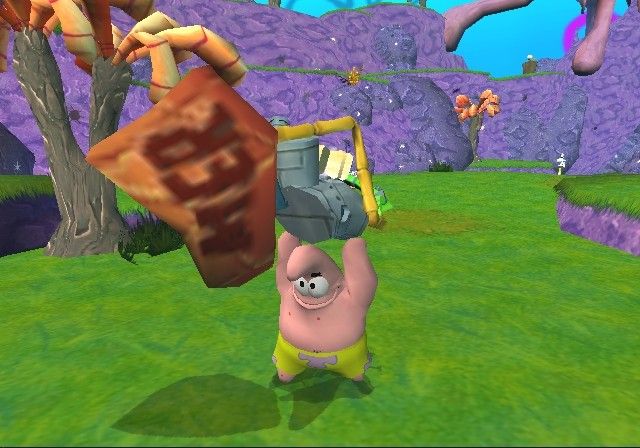
SpongeBob, Patrick and Sandy were all playable, with different moves and abilities. SpongeBob could learn extra bubble-based techniques, Patrick used objects such as fruit in combat and puzzles, while Sandy’s lasso and glide allowed her to cross gaps and reach places the others could not. Bus Stops allowed the player to change character where appropriate. The structure was deliberately accessible, but later areas and some timed challenges could be surprisingly demanding for a game aimed at younger players. The PAL release supported one player and had no multiplayer or online component.
UK release and versions
The British PAL release used serial number SLES-51968 and arrived on Friday, 28 November 2003. The PAL disc is listed as having English menus and gameplay, a single-player mode and a minimum save requirement of 248 KB on a PlayStation 2 memory card. The home-console edition used RenderWare and was developed by Heavy Iron Studios; THQ handled publication. A dependable contemporary UK recommended retail price has not been established, so no launch RRP is recorded here.
The PlayStation 2, GameCube and Xbox versions were the comparable 3D platform games. The Game Boy Advance version was a separate 2D platformer, while the Windows release was a different mini-game compilation rather than a straight conversion of the console game. The PAL PS2 edition should therefore not be confused with either of those versions, or with the later remake.
Reception
Contemporary critical opinion was mixed rather than disastrous. The PlayStation 2 version holds a Metacritic score of 71 out of 100 from nine critics, placing it in the “mixed or average” category. IGN awarded 7.3 out of 10, praising the sound, cartoon presentation and variety within its familiar platforming formula. GMR was more positive at 8 out of 10, while 1UP gave 5 out of 10 and Game Informer 4.3 out of 10, objecting to the game’s conventional design and limited originality.
The most consistent praise concerned the use of the television series’ characters, voice work, locations and humour. The main criticisms were repetition, basic combat, occasional awkward level design and the amount of collecting required for completion. In other words, it was recognised as a competent children’s platformer with more care than many licensed games, but not generally treated in 2003 as a major rival to the best first-party 3D platformers.
Legacy and playing it now
Battle for Bikini Bottom developed a stronger reputation after release. It gained a cult following and an unusually committed speedrunning community, helped by the game’s open routes, glitches and exploitable movement. That renewed interest contributed to THQ Nordic’s 2020 remake, SpongeBob SquarePants: Battle for Bikini Bottom – Rehydrated. The remake rebuilt the presentation for modern hardware, restored content cut from the original and added multiplayer for the first time; those features do not exist in the original PS2 game.
For an authentic PAL experience, the original disc is still best played on a PlayStation 2. Some early European PlayStation 3 models were designed to play most PlayStation 2-format discs, although Sony warned that compatibility varied by model and that some games could behave differently. Modern players who do not have suitable legacy hardware can use Rehydrated, but it is a remake rather than a direct PS2 emulation release.
Screenshots (12 Jan-2006)
Videos
Frequently asked questions
Did SpongeBob SquarePants: Battle for Bikini Bottom have an online mode on PS2?
No. The original PS2 release was an offline, single-player game. Multiplayer was added much later in Battle for Bikini Bottom – Rehydrated, not patched into the PS2 version.
Is the UK PAL version different from the US version?
The UK edition is the PAL release with serial SLES-51968, English menus and gameplay, and a 28 November 2003 release date. It is the same home-console adventure in broad content terms, although regional packaging and technical format differ.
Can the original PS2 disc be played on PS4 or PS5?
The original disc should be treated as a PS2-format release, not a PS4 or PS5 disc-compatible game. Use a PS2, or a compatible early PS3 model; Rehydrated is the modern PlayStation alternative.
What is the difference between the PS2 game and Rehydrated?
Rehydrated is a full remake with updated visuals, restored material that was cut from the 2003 release and a new multiplayer mode. The original PS2 game remains single-player and uses its original RenderWare-era presentation.
Does the PS2 game need a memory card?
Yes. The PAL release is documented as requiring a minimum of 248 KB of PlayStation 2 memory-card space for saves.