Unlimited Saga Review
A short, tacky review of a slow, long, intricate game
In the crazy land of Mike where up is down, right is wrong, and Hoffa ain’t dead, we write our reviews backwards.
In Closing
This isn’t going to make any sense, but I’m going to say it anyway; there are games that are bad because they are poorly made, and there are games that are bad because they are too well made. Unlimited Saga is one of the latter. The developers spent so much time making it, and got so far up into their own heads, that they seemed to have little regard for the people who would have to play it. A super-intricate system with no tutorials? 50+ hours of looking at 3 different main character sprites? A story that’s so detail based that it deserves it’s own cliff notes? The game is not without merit – The music is fine and it’s probably one of the longest console RPGs ever – but it takes such an investment in time, patience, sanity, and good will that the vast majority of casual gamers need not apply.
Replay Value
Unlimited Saga definitely delivers in this area. It takes anywhere from 30 to 50 hours to beat with your first character (probably Laura), depending on how quickly you catch on to the system and how many extra objectives you take on. And after you have beaten the game once, the six additional characters all have full quests that can take anywhere from 15 to 30 hours apiece. While a lot of games (like Xenosaga) claim to have over 80 hours of gameplay, Unlimited Saga is the first game that I’ve ever run across that contains over 100 hours of actual game to get through. Not side quests, and not minigames, but over 100 hours of real content. And add to that the fact that most of the characters have multiple story branching points and/or endings……. well you’re looking at one monster game. The different characters all play very differently too. Laura and Ruby both have long, balanced quests, with an average difficulty level, and a minimum amount of extra questing to be done. Ventus is a postal carrier and his story revolves around taking various jobs in order to get enough money to progress to the next area. Judy is a young witch in training, so her quest revolves around mastering the magic system. Armic the Chapa (a humanoid squirrel race) is an extremely weak character, so he must do lots of treasure hunting for good equipment in order to survive. And finally, Kurt and Mythe’s quests are just very difficult (Kurt more so than Mythe), and designed to be played after you have beaten the game with a few characters, and are well versed in combos, skills, etc. Actually, there might be an eighth, epilogue type quest when 1-7 are done, but I have thus far been unable to locate anyone who has beaten them all 7 to confirm or deny this.
Now I’m all for getting a good bang for your buck, but I can’t help but wonder how long is too long? Who has that kind of time to spend on one game? Hell who has that kind of time to spend on gaming in total!? I can see buying this game if you’re the kind of person who doesn’t play a lot of games at all; maybe one a year that you whittle away at over several months. But I have a funny feeling that if you’re visiting a video game website like this you are not really that kind of a guy…
Sound
Well the soundtrack certainly doesn’t disappoint. There are lots of epic, sweeping tracks, but also a lot of simpler (but still beautiful) piano-based songs. A lot of the melodies have a very bittersweet quality to them. They’re soulful and a little sad, but at the same time not at all dreary or repetitive. Most of the game is not voiced, but when the actors do speak their lines, it comes off pretty believably.
Graphics
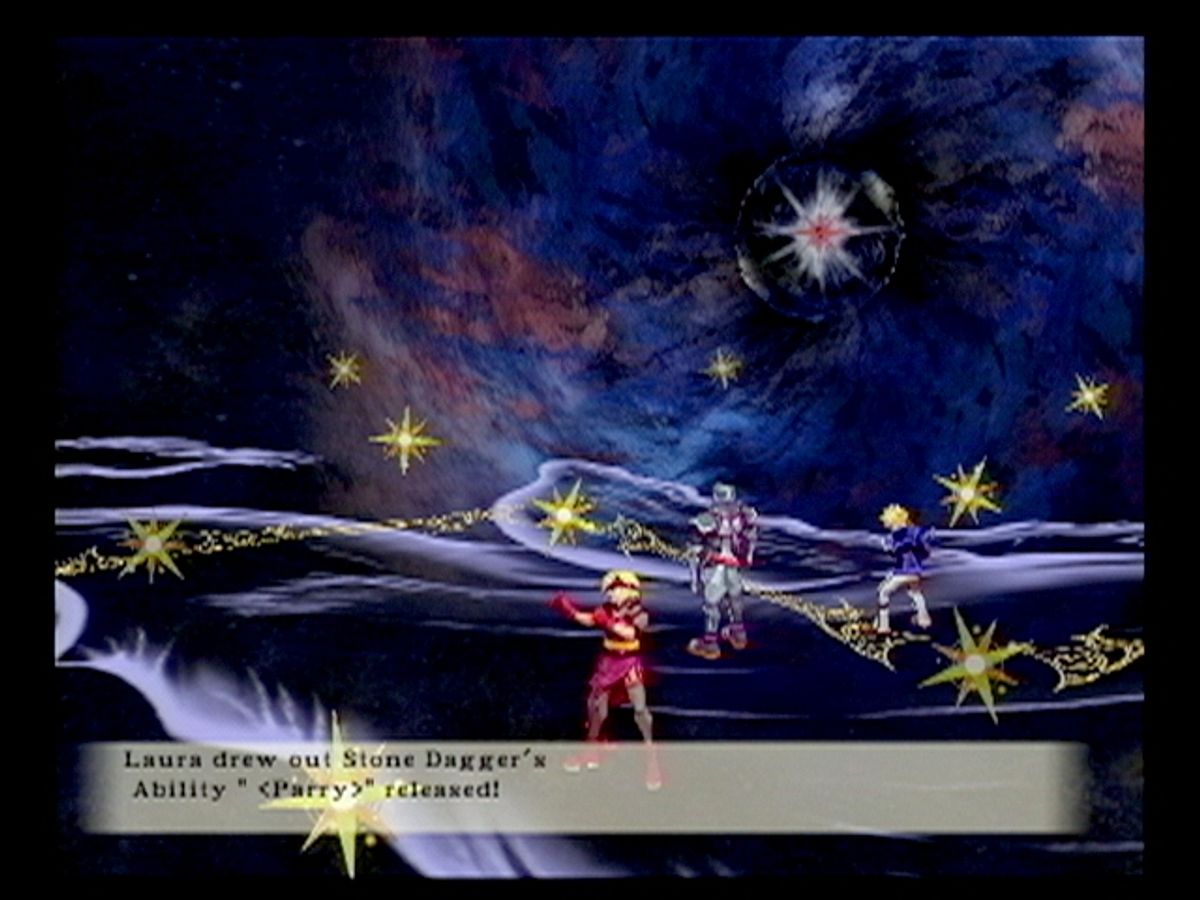
Experimental is the best way to describe them. On one hand the game is sprite based, so my interest was immediately piqued. There’s nothing I like more than a well done sprite based game. I’ve read every Disgaea preview out there merely by virtue of the fact that it is indeed entirely sprite based. But what the creators of Unlimited Saga did here was really just too weird to work. They decided to use the highest quality sprites available, but at the cost of any fluidity whatsoever. The sprites themselves are extremely detailed, and look like they were lifted right off an artist’s easel, but because they are so detailed, there was no room left on the disc for much animation and/or variance. No character (be it party member or foe) has more than a handful of animation routines, and the ones that do exist look choppy and canned. Many characters don’t even have an idle animation, and are reduced to flipping back and forth during battle. The designers tried to compensate a little by adding lots of scaling effects, but it’s a poor substitute for real animation. The game quickly becomes a bore to watch, as you’ll see the exact same still shot of your character for an umpteen number of hours.
Though, now that I think about it, I suppose the graphics weren’t totally beyond redemption. Since there was so little movement, the entire game could have been set up like a story book. Moving to different areas could have been signaled by the flipping of a page, and each character could have been set up like a separate chapter too. Since towns are simply matte paintings that you move a cursor around on, Squaresoft could have conceivably created some kind of finger moving across a page effect. Games like Paper Mario have certainly made this idea work, so I don’t see why Unlimited Saga wasn’t set up in a similar manner. It’s too bad too, since I really dug the character and set design quite a bit.
Gameplay
The game system is very weird, but also very interesting. The game interface is truly a modern mystery, as there is no visual representation of your character in town, and he/she looks like a chess piece in dungeons. Towns are represented by paintings, with a number of locations written on them that you can visit. Since every area is simply a painting, the game never really draws you into the world. It doesn’t really feel like you’re visiting a new town, but rather a new set of menus. You progress and gain new party members only by entering the inn and talking to guests. The game is broken up into quests, and you start each new adventure simply by choosing “begin quest” from the inn menu. Though there are certainly a lot of extra side quests to partake in, as well as more than a few branching points, the overall quest is a very structured experience. Go to the inn, see what the people in town have to say, and start the next adventure. Dungeons are represented with a series of spots, just like a board game, and you simply plop your character from one gray area to the next, praying that you’ll find the exit. You randomly run across treasure chests and traps (which are activated with the slot system (see below)) and monsters which you may or may not have to fight, depending on your stats. The maps are big, barren, and completely without landmarks, which is quite a problem later in the game, when quests start to have turn limits.
The growth system is also quite a marvel. Each character has both a health power gauge and a life points gauge, but the term “health points” is not used in the same way that every other video game in the world uses it. It would have been far wiser to call it the ability point gauge, because that’s what it measures; ability. Hp is consumed when you attack, move, open chests, and fall into traps. It serves as a buffer for your life points (your real health), and the more hp you have, the less life you loose. There are also no levels in the game, and instead you are given the option to raise each character’s fluency in one area after each quest is completed. Each character has a honeycomb-shaped grid that you can fill with a certain number of skills, and after each quest, you can choose to learn one new skill. Skills range from mastery with a certain weapon to increased health, and certain skills fare better in certain spots and can become more or less potent depending on what they are placed next to. But none of this is explained in the game, and there are absolutely no tutorials either. And since you can’t level up at will (only at the end of a quest), there is little room for experimentation.
The battle system is beyond comparison as well. You have five turns at your disposal to use as you see fit. You could have one character attack five times, or have a mix of several party members. But because of the nature of “hp,” one character cannot do all the work, so the game forces you to mix it up a little. Hp is used up rapidly no matter what you do, so you will have to let each character rest and regain some from time to time. Your available attacks are based on your equipment, and you can choose to chain your attacks together with each other, with a friends attacks, or simply attack one by one. If you attack separately a slot machine comes up, and if you’re really lucky you can time a critical hit. But this really isn’t much more innovative than the horrible Judgment Ring system in Shadow Hearts, and unlike that ring the slots move way too fast to actually time anyway. Attacks become more powerful if you combine them, but if an enemy breaks the attack the combo ends, and you have to start over. The game manual suggests that you “experiment” and learn how fast enemies are, but this seems like a fairly ludicrous suggestion to me. Try out every available combo on each new enemy you see? What about bosses that you fight once? Your characters can learn new skills through “sparks of inspiration,” but like everything else in the game, the method is somewhat random. There are things you can do to increase your chances (fighting big enemies, using the highest level skill available), but whether you learn the new skill or not is entirely up to chance. And there are of course no tutorials for any of this either. Any system built entirely on experimentation is sure to be difficult, but the pleasure of discovery is not something to be understated either. There is certainly something to be said for finding some new skill on your own, as opposed to learning it standard at level 23 or whatever. But in my opinion, things are simply more frustrating than fun here, and I honestly did not enjoy much of the saga.
Story
I don’t know whether I liked the story or not. It was a little too complicated for me to follow, mainly because the name-dropping was absolutely insane. The characters were constantly referencing obscure kingdoms and dynasties that you never actually visit in the course of the game. I felt like I had missed some prep reading or something. Not that the plot is anything terribly special; royal conspiracies, and a whole lot of crap about the destiny of this and the destiny of that. I did like the fact that the characters all had personal reasons for embarking on this grand quest though. I’ve played far too many games where the main character is able to recruit lifelong companions simply because they’re there. The characters in the game all had personal goals and motivations beyond simply “saving the world,” which certainly gave the plot some much needed humanity.