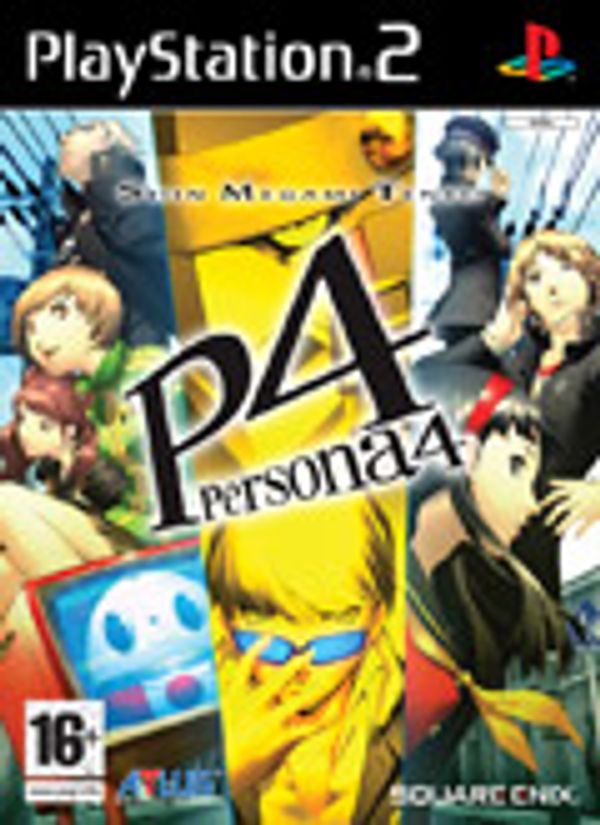
Shin Megami Tensei: Persona 4
About Shin Megami Tensei: Persona 4
From the archive
This is the original PS2Home fact sheet for Shin Megami Tensei: Persona 4, preserved from the early-2000s archive. Details reflect the PAL release as catalogued at the time.
Official fact sheet
Shortly after an urban youth begins a year-long stay in the countryside town of Inaba, the rural town’s peace is shattered by a horrific murder that leaves no clues or suspects. As the lone incident develops into a series of bizarre crimes, he discovers that only he and his friends have the power to solve the baffling case, bring those responsible to justice, and restore harmony to his new home.
- Balance your double life ? Beyond intense battles, Persona fusion, and new weapon creation exists a normal high school life of friends, classes, and part-time jobs. The way you manage and integrate your activities within each day will determine how you progress through the game.
- Unprecedented team control ? With a greater emphasis on developing bonds in the fight to solve the mysterious murders, strong friendships are key to your success. Directly control teammates in battle, earn greater party support for combat, and master individual Social Links to unlock your party’s true potential.
- Find the true ending ? 60 hours of gameplay thrusts you into a deep mystery where midnight television leads to serial killings. You must investigate murders, rescue those who can be rescued, and unmask the culprit behind it all?or risk being forever shrouded in the fog of doubt.
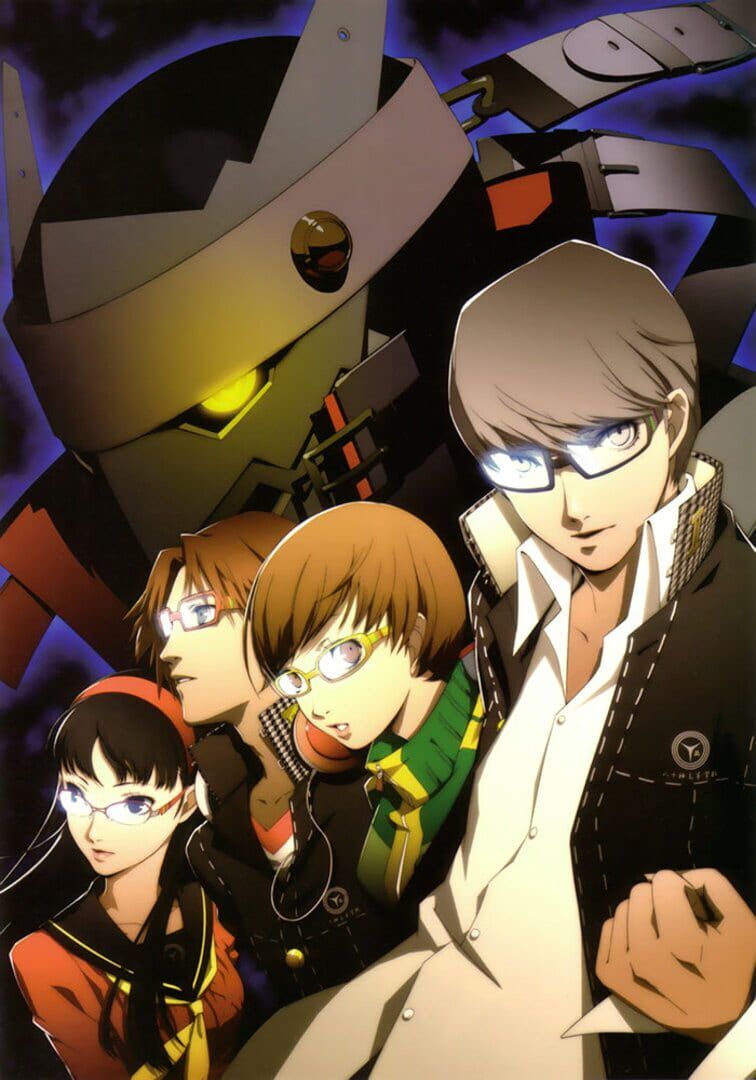
Shin Megami Tensei: Persona 4 was Atlus’s 2008 PlayStation 2 role-playing game, released in Japan as Persona 4 and outside Japan with the Shin Megami Tensei subtitle. It followed a city teenager spending a school year with his uncle and cousin in the rural Japanese town of Inaba, where a series of murders became linked to an urban legend known as the Midnight Channel. The game combined turn-based dungeon crawling with school life, relationship-building and time management, making it one of the most distinctive late-period PS2 RPGs.
Story and setting
The protagonist moved to Inaba while his parents worked abroad and enrolled at Yasogami High School. He lived with his detective uncle Ryotaro Dojima and young cousin Nanako, initially expecting an uneventful year. That changed after a murder and a series of disappearances unsettled the town.
The central rumour claimed that a person’s soulmate would appear on a switched-off television at midnight during rainy weather. Investigating the Midnight Channel led the protagonist and his school friends into the TV World, a fog-filled alternate reality inhabited by Shadows. With the help of the creature Teddie, they awakened Personas, supernatural manifestations of the self, and formed the Investigation Team. The murder mystery provided the main thread, while the characters’ personal fears and insecurities supplied the game’s more psychological material.
How it played
Persona 4 divided its year-long story into individual days. During daylight hours the protagonist attended lessons, took part in school activities, explored Inaba, studied, worked part-time jobs and spent time with other characters. These relationships were represented by Social Links. Developing them improved the corresponding Arcana and provided practical benefits when Personas were created or used in battle. The structure demanded choices about how to spend limited time rather than allowing every activity to be completed in one playthrough.
The TV World contained a series of themed, procedurally arranged dungeons rather than one continuous landscape. Combat was turn-based, with physical attacks, weapons and Persona skills built around elemental strengths and weaknesses. Exploiting an enemy weakness could knock it down, grant an extra turn and contribute towards an All-Out Attack. The protagonist’s Wild Card ability allowed him to carry and switch between multiple Personas, while Igor’s Velvet Room enabled Persona fusion. Unlike Persona 3, the original game allowed direct commands for the other party members. It was a story-heavy RPG with social-simulation elements, not an open-world game.
PAL and UK release
The Japanese version launched on 10 July 2008, followed by North America on 9 December 2008. Square Enix Ltd handled the European and other PAL releases, which arrived in the UK on Friday, 13 March 2009. Contemporary UK listings gave the game a price of £19.99, unusually modest for a substantial new RPG at the end of the PS2’s commercial life.
The PAL edition was a two-disc package containing the game and a separate 24-track soundtrack CD. The European product was rated PEGI 16+. It was a single-player release, used a PlayStation 2 memory card for saving, and had no online mode. The original western PS2 version used English text and English voice acting; selectable Japanese voices were associated with later releases of Persona 4 Golden rather than this edition.
Reception
Persona 4 was strongly received by critics, although reviews noted that its large amount of dialogue and deliberate pacing would not suit everyone. GameSpot awarded it 9/10, praising its cast, combat and blend of role-playing with social simulation. IGN’s review scored it 9.3/10, while Eurogamer and Edge both awarded 9/10. Famitsu gave it 35/40. Common reservations included repetitive dungeon presentation, reused enemy and Persona designs, occasional loading pauses and stretches where the story advanced more slowly than the action.
The game also received recognition in Japan, including the PlayStation 2 Game Prize at the Famitsu Awards and an Award for Excellence at the 2009 Japan Game Awards. Its reputation grew beyond its original audience because the murder mystery, character writing, music and everyday school setting gave the familiar RPG structure an unusually personal focus.
Legacy and versions
Persona 4 became one of the PS2’s defining late releases and established the template that later Persona games expanded. Persona 4 Golden, first released for PlayStation Vita in 2012, added a new character, new Social Links, extra events, additional dialogue, new areas and quality-of-life improvements. Golden later reached Windows, PlayStation 4, Nintendo Switch and Xbox platforms. Those versions are easier ways to play the story today, but they are expanded editions rather than the original PS2 game.
For an authentic UK experience, the PAL disc remains the relevant version, with its 50Hz-era presentation, English-only PS2 localisation and bonus soundtrack CD. A PAL PS2 is the simplest hardware option. Some early European PS3 models could play most PS2 discs, but later PS3 systems removed that facility and Sony warned that compatibility could vary. The original game therefore remains a useful snapshot of Atlus’s PS2 design before the series became a much larger international name.
Screenshots (07 Jul-2008)
Artwork
Videos
Frequently asked questions
What is the difference between the UK PAL version and the US version?
Both are English-language versions of the same PS2 game. The UK PAL release was published by Square Enix, arrived on 13 March 2009, carried a PEGI 16+ rating and included a 24-track soundtrack CD.
Can Persona 4 PS2 play on a PlayStation 3?
Only some early European PS3 models supported most PS2 discs, including the CECHC02, CECHC03, CECHC04 and CECHC08 families. Later PS3, PS4 and PS5 consoles do not generally play the original PS2 disc directly.
Is the UK PAL copy rare?
It is less commonly encountered than the North American release, but there is no official rarity classification or stable price. Complete copies with the soundtrack CD and manual are the versions collectors usually seek.
What is the best way to play Persona 4 today?
For the original game, use a PAL PlayStation 2 and the UK disc, with a PS2 memory card for saves. For a more accessible modern release, Persona 4 Golden is available digitally on PC, PlayStation 4, Nintendo Switch and Xbox platforms, but it contains substantial additions and is not identical to the PS2 version.