Shin Megami Tensei: Persona 3
About Shin Megami Tensei: Persona 3
From the archive
This is the original PS2Home fact sheet for Shin Megami Tensei: Persona 3, preserved from the early-2000s archive. Details reflect the PAL release as catalogued at the time.
Official fact sheet
In Persona 3, you?ll assume the role of a high school student, orphaned as a young boy, who?s recently transferred to Gekkoukan High School on Port Island. Shortly after his arrival, he is attacked by creatures of the night known as Shadows. The assault awakens his Persona, Orpheus, from the depths of his subconscious, enabling him to defeat the terrifying foes. He soon discovers that he shares this special ability with other students at his new school. From them, he learns of the Dark Hour, a hidden time that exists between one day and the next, swarming with Shadows. These monsters have been steadily claiming victims aptly nicknamed ?The Lost??people who?ve inexplicably become mindless zombies. Under the supervision of school chairman Shuji Ikutsuki, he joins his new companions in confronting this threat to humanity?
- Engaging Social Link system lets you build intimate relationships with friends and love interests alike!
- Unforgettable characters and professionally-acted dialogue bring the story to life!
- Massive replay value with over 20 Social Links and a complex storyline encompassing a full school year.
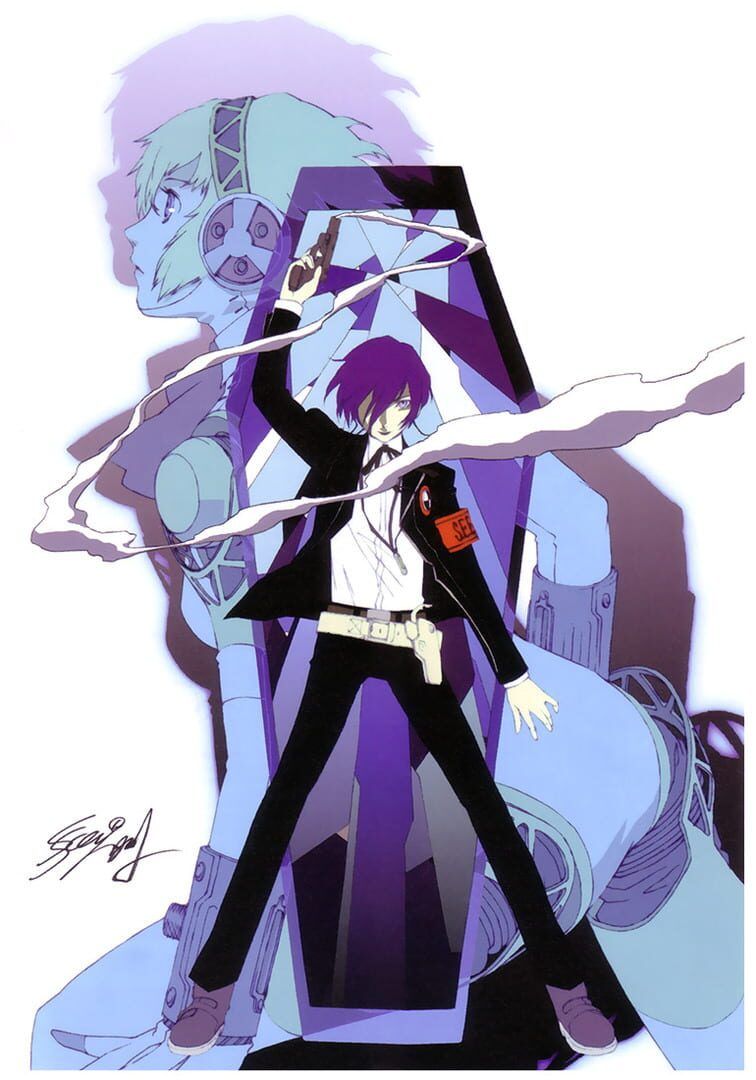
- Highly stylized designs grace the beautiful 2D character portraits, detailed 3D animations, and heart-pounding cut scenes!
- Intense, strategic battle system; find and exploit enemy weaknesses with the help of your allies!
- Bonus Material:
- A full-color, 52-page art book packed with character art, concept sketches, and more!
- Soundtrack CD featuring the hip urban-techno music of Shoji Meguro, composer of the haunting and unforgettable scores for Nocturne and Digital Devil Saga!
- A striking collector?s box to store your game and all the extra goodies!
Shin Megami Tensei: Persona 3 was a PlayStation 2 role-playing game developed by Atlus and released in Britain on Friday, 29 February 2008. It combined turn-based demon battles with a day-by-day school-life simulation, asking the player to divide a single school year between ordinary teenage routines and nightly battles against Shadows. Its presentation was distinctly Japanese, but its themes of friendship, grief, fear and mortality gave it a broader emotional reach. The PAL release arrived late in the PlayStation 2’s life, yet became one of the console’s most respected and distinctive role-playing games.
Story and setting
The player names and controls a quiet male transfer student who arrives at Gekkoukan High School on Tatsumi Port Island and moves into a student dormitory. He soon discovers the Dark Hour, a hidden period at midnight during which most people become inert human-shaped coffins and the familiar world changes into something hostile. Gekkoukan High School becomes Tartarus, a vast tower filled with Shadows, creatures associated with the darker impulses of humanity.
The protagonist is recruited into SEES, the Specialized Extracurricular Execution Squad. Its members include Yukari Takeba, Junpei Iori, Akihiko Sanada and Mitsuru Kirijo. They investigate the Dark Hour, climb Tartarus and confront major Shadows that appear around the full moon. Personas, manifestations of the self, are summoned with gun-shaped Evokers. The imagery is striking, but the story treats the device as part of a wider discussion about fear, death and the choices people make when confronted with their own mortality.
How it played
Persona 3 divided its year into a calendar of school days, evenings, holidays and exam periods. During the day, the protagonist attended lessons, improved personal attributes such as Academics, Charm and Courage, joined clubs, visited shops and spent time with other characters. These relationships formed Social Links, which developed through short storylines and improved the results of Persona fusion for the corresponding Arcana. Time was limited, so every decision involved sacrificing another possible activity.
The Dark Hour provided the combat side of the game. Tartarus was a largely randomly generated tower whose floors were explored in blocks as the story progressed. Battles were turn-based and centred on exploiting elemental weaknesses, knocking enemies down and triggering All-Out Attacks. The protagonist could change between several Personas, while other party members used their own Personas. In this original PS2 version, the player directly controlled only the protagonist and issued general Tactics to the other characters, a system that gave the party personality but could also produce frustrating decisions from the artificial intelligence. Persona fusion, equipment, skill selection and preparation for full-moon bosses supplied much of the long-term strategy.
Style and production
Persona 3 stood apart from the more conventional fantasy settings associated with role-playing games. Its school corridors, shopping streets and seaside city were presented alongside anime scenes, illustrated dialogue portraits, surreal monsters and a soundtrack by Shoji Meguro that used pop, hip-hop and lounge influences as readily as traditional dramatic scoring. The game’s 3D presentation was functional rather than technically lavish, but the character designs, Personas and colour direction gave it a coherent identity.
The mixture of social simulation and dungeon crawling was not an incidental side feature. The calendar made relationships, fatigue, revision and leisure part of the same structure as levelling and equipment. That connection between ordinary life and supernatural danger became the model that later Persona games refined.
UK release and versions
The game was released in Japan on 13 July 2006, in North America on 14 August 2007 and in Europe on 29 February 2008. The European edition was published by Koei Europe. Tecmo Koei was the later corporate name and should not be backdated as the publisher of the original British release. The UK disc was a PAL PlayStation 2 release and was a single-player game with no online component.
This entry should not be confused with Persona 3 FES. FES was an expanded PS2 release containing an updated version of the main story, known as The Journey, and the additional post-game chapter The Answer. Koei released the European FES edition on 17 October 2008, less than eight months after the original PAL game. The original Persona 3 therefore remains a distinct version, without FES’s additional chapter and later adjustments.
Reception
Persona 3 was received particularly well by specialist role-playing and PlayStation publications. GameSpot awarded it 8.5/10 and praised its unusual combination of social simulation, dungeon exploration and dark storytelling. The UK Official PlayStation 2 Magazine gave it 10/10 in its February 2008 issue, calling it imaginative and worthy of top marks. The UK Official PlayStation Magazine scored it 9/10 in its March 2008 issue. Metacritic’s PlayStation 2 aggregation recorded a critic score of 86/100.
The reservations were just as recognisable. Tartarus could become repetitive, the long calendar sometimes demanded considerable patience, and the original battle system’s reliance on party AI was less forgiving than later versions. Those limitations did not prevent Persona 3 from becoming one of the late PS2’s most acclaimed role-playing games.
Legacy
Persona 3 is widely regarded as the point at which the modern Persona formula took shape. Social Links, a yearly calendar, school-life choices and a supernatural party story all became central elements of Persona 4 and Persona 5. Its influence also extended beyond mechanics: the idea that personal relationships could be as important to progression as equipment or experience levels became a defining feature of the wider series.
As of 3 October 2026, the original PS2 game remains historically important, even though later editions are more accessible. Persona 3 FES expanded the PS2 experience, Persona 3 Portable reworked it for PSP and added a female protagonist, and Persona 3 Reload rebuilt the game for modern systems. None of those versions makes the original PAL disc irrelevant to the archive: it documents the first European release of the game that established Persona’s later direction.
Screenshots (02 May-2007)
Artwork
Videos
Frequently asked questions
Is the original PS2 game the same as Persona 3 FES?
No. Persona 3 FES is an expanded PS2 edition with changes to the main campaign and the additional playable epilogue The Answer. The original PAL release contains the original campaign only.
What are the main UK and regional differences?
Japan released the game simply as Persona 3, while the Western editions used the Shin Megami Tensei: Persona 3 title. The European version arrived later than the Japanese and North American editions and was published by Koei rather than Atlus.
Can the original PAL disc be played on a PS3?
Only selected early PS3 models can play PS2 discs, and Sony warned that compatibility and performance varied by software and hardware. A PAL PlayStation 2 with a PS2 memory card is the most reliable original-hardware option.
Is the PAL copy rare?
It was a niche late-generation release rather than a mass-market PS2 title, so complete PAL copies can be harder to find than common releases. There is no official rarity classification, and asking prices fluctuate.
Did Persona 3 have online multiplayer?
No. The PS2 game was designed for one player and has no online multiplayer or online campaign features.