Final Fantasy X
About Final Fantasy X
From the archive
This is the original PS2Home fact sheet for Final Fantasy X, preserved from the early-2000s archive. Details reflect the PAL release as catalogued at the time.
Official fact sheet
Immerse yourself in a world that has been devastated by a mysterious force known only as “Sin”. Human existence teeters on the brink of extinction when Sin willfully destroys cities and lives. Final Fantasy X makes history by being the first Final Fantasy installment to integrate voiceovers into a majority of the story scenes. Along with a special effects system known as the “Facial Motion System,” this feature breathes new life into the characters, story, and the Final Fantasy series itself.
- The first Final Fantasy game for the PS2.
- The first in the history of the Final Fantasy installments to integrate voiceovers into a majority of the story scenes.
- Features a special effects system known as the “Facial Motion System,” which adds subtle facial expressions to characters in real time.
- Fully 3D environments that seamlessly integrate real-time movement with boss battles, allowing players to wander an area and engage in fights on the same screen.
- Newly designed battle system that integrates traditional Final Fantasy battle elements with a unique Sphere Grid character development system.
- Life-like, high-polygon, motion-captured characters designed by renowned artist Tetsuya Nomura.
- Enchanting musical score, written by famed composer Nobuo Uematsu, with tracks featuring a distinct Japanese Okinawan flavor.
- All new side quests and minigames, such as the underwater sport of blitzball and a monster arena.
Final Fantasy X was Square’s first mainline Final Fantasy for PlayStation 2 and one of the defining Japanese role-playing games of the sixth-console generation. It combined a more cinematic presentation with a traditional party-based adventure, introducing fully 3D explorable locations, voiced dialogue, facial animation and a new turn-based battle system. The result was more linear than earlier entries, but also more focused, character-led and emotionally direct. The Japanese version appeared on 19 July 2001, while the UK received the PAL release on Friday, 24 May 2002. For British players, that version was particularly notable because it included much of the expanded International content, although its 50Hz conversion and large display borders were criticised at the time.
Story and setting
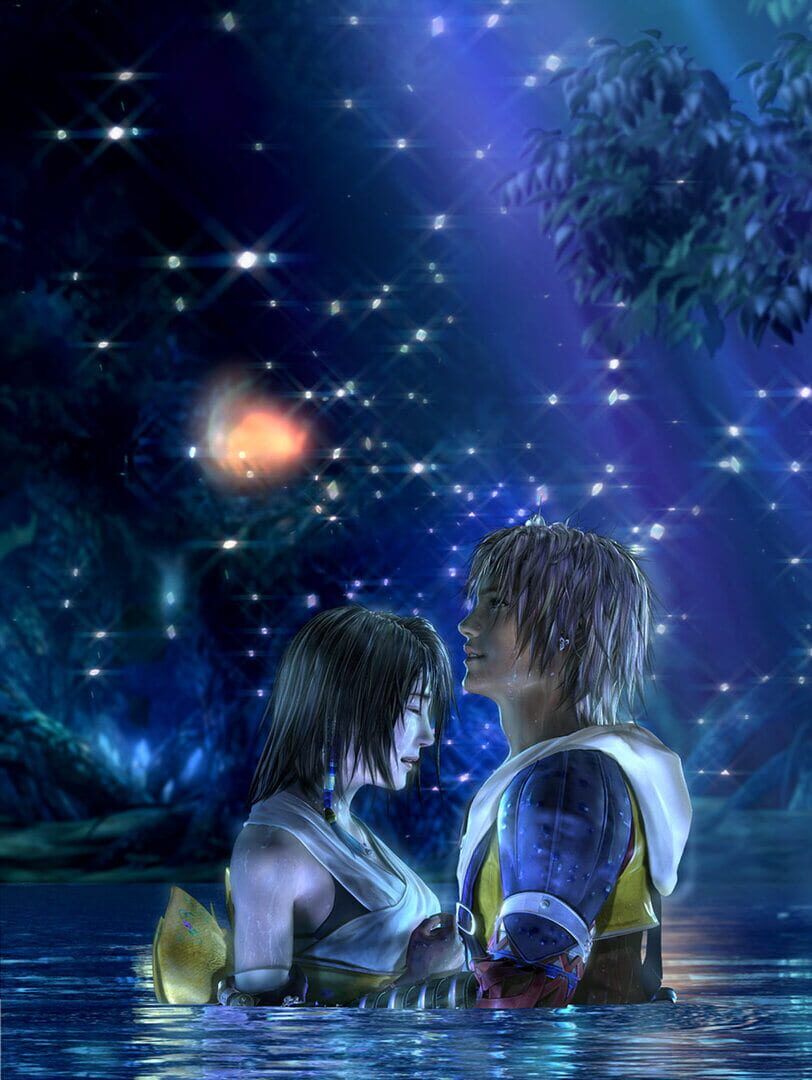
Final Fantasy X is set in Spira, a world repeatedly devastated by Sin, a colossal creature that destroys cities and leaves death and destruction in its wake. Tidus, a celebrated blitzball player from Zanarkand, is caught up in Sin’s attack and separated from his home. He is brought to Spira, where the culture, technology and religious customs are unfamiliar to him, and begins travelling with the summoner Yuna and her guardians.
Yuna’s pilgrimage is intended to end with the Final Summoning, the traditional means of defeating Sin and bringing about a period of peace known as the Calm. The journey examines faith, duty, sacrifice, grief and the relationship between Tidus and Yuna. Its tone moves between adventure, drama and romance, with Spira’s religious traditions and its treatment of the dead giving the story a darker foundation than its colourful environments initially suggest.
How it played
Exploration used a third-person view across connected, real-time 3D environments rather than the pre-rendered backdrops used by much of the PlayStation-era series. Final Fantasy X did not use the traditional world map: routes between settlements were generally continuous and fairly linear, with greater freedom becoming available later through the airship. Random battles remained part of the design, and towns, temples and wilderness areas were linked by a clear forward journey.
Combat replaced the previous games’ Active Time Battle system with Conditional Turn-Based Battle. The turn order was displayed on screen and could be altered by abilities, spells and status effects, allowing more deliberate planning. Characters could be exchanged during a battle, making it practical to use each party member’s strengths against particular enemies. Progression was handled through the Sphere Grid, which let players spend earned ability points to move characters through a network of stat increases, spells and abilities. Summoned aeons, character Overdrives, equipment customisation and the underwater sport of blitzball provided additional systems, while optional challenges and endgame superbosses greatly extended the adventure.
PAL and UK release
The UK release was developed by Square Co., Ltd. and published in Britain by Sony Computer Entertainment Europe. It carried an ELSPA 11+ rating, as PEGI had not yet replaced ELSPA in the UK. Contemporary British listings put the game at £44.99, the standard high-end price for a major PlayStation 2 release at the time.
The PAL edition was based on the expanded Final Fantasy X International version rather than the earliest Japanese and North American releases. It added the Expert Sphere Grid, extra equipment options and powerful optional opponents including the Dark Aeons and Penance. The original black-label UK package also included the Beyond Final Fantasy DVD, containing interviews, trailers, artwork and music material. The technical conversion was less welcome: the game ran at 50Hz, with visible black borders and no 60Hz option, issues that were repeatedly noted in European coverage.
Reception
Final Fantasy X was received very strongly overall. Famitsu awarded it 39 out of 40, while IGN scored it 9.5 out of 10 and GameSpot’s Greg Kasavin gave it 9.3. The wider critical average settled at 92 out of 100 on Metacritic. Reviewers praised the visual presentation, soundtrack, battle system, voice acting and the way its characters carried the story.
The response was not unanimous. Edge gave it 6 out of 10, and The Guardian awarded three stars while objecting to the unskippable cut-scenes, linear progression and some of the dialogue. Those reservations have remained part of the game’s reputation: its storytelling and combat are widely admired, but its corridors, frequent interruptions and uneven English performances can feel dated.
Legacy
Final Fantasy X became a major commercial success, shipping more than 8.5 million copies worldwide on PlayStation 2. It was followed by Final Fantasy X-2 in 2003, the first direct sequel to a mainline Final Fantasy game. Its Sphere Grid, voiced cinematic scenes and more continuous 3D world helped establish the direction of later entries, even though subsequent games moved away from its exact battle system.
The game remains one of the most highly regarded story-driven RPGs of the PS2 era. Final Fantasy X and X-2 were later remastered for PlayStation 3 and Vita, followed by PlayStation 4, PC, Nintendo Switch and Xbox One releases. In 2026, the HD Remaster also reached Nintendo Switch 2, keeping the adventure available on modern hardware while the original PAL disc remains the best way to experience the game as a period PS2 release.
Screenshots (01 Sep-2001)
Artwork
Videos
Frequently asked questions
Is the UK PS2 version of Final Fantasy X different from the American version?
Yes. The PAL release is based on Final Fantasy X International and includes the Expert Sphere Grid, Dark Aeons, Penance and other additions absent from the original North American release. It also has the PAL 50Hz presentation and, in the original UK package, the Beyond Final Fantasy bonus DVD.
Can I play the original PS2 disc on a PS5?
No. PlayStation 2 software cannot be played directly from a PS5 disc drive. The PS4 version of Final Fantasy X/X-2 HD Remaster is playable on PS5, but it is a remaster rather than the original PAL disc release.
What is the best way to play Final Fantasy X now?
Use the original PAL disc on a working PlayStation 2 if you want the authentic UK version. The HD Remaster is more convenient on PS4, PS5 through PS4 compatibility, PC, Xbox, Nintendo Switch or Nintendo Switch 2, and includes the expanded International content.
Is the PAL PS2 release rare?
No, not usually. Standard copies are frequently found second-hand, although complete black-label examples with the Beyond Final Fantasy DVD, case, manual and original inserts are more desirable to collectors.