Dancing Stage Max (Aka Dance Dance Revolution Extreme 2)
About Dancing Stage Max (Aka Dance Dance Revolution Extreme 2)
From the archive
This is the original PS2Home fact sheet for Dancing Stage Max (Aka Dance Dance Revolution Extreme 2), preserved from the early-2000s archive. Details reflect the PAL release as catalogued at the time.
Official fact sheet
Dancing Stage is renowned for its incredible mixture of music styles, and Dancing Stage Max features an incredibly strong array of music talent. New tracks include ‘These Words’ by Natasha Beddingfield, Franz Ferdinand’s ‘Michael’ and ‘In the Middle’ by the Sugababes. Classic pop acts are also well represented with ‘Goody Two Shoes’ from Adam and the Ants, ‘You Sexy Thing’ by Hot Chocolate, and Lulu’s ‘Shout.’
- The new game modes have been designed to offer users a concentrated challenge, with the new ‘Dance Master Mode’ leading the line. This sets the player a series of small tasks each set to music, with players selecting a soundtrack before being asked to match certain targets to earn points. Similarly, Dancing Stage Max’s ‘Advanced Mode’ is aimed at experienced fans of the game, with four different game styles unlocked as the player progresses. These include the classic ‘Course’ and ‘Endless’ modes from previous games wherein players play against a single tune or until a gauge is exhausted.
- Also unlockable via the ‘Advanced Mode’ are the ‘Survival’ and ‘Combo Challenge’ Modes, both of which are extremely hard to master. In ‘Survival’ mode players are charged with continually scoring highly in the game. If they drop to a ‘Good’ or lower rating more than four times they are disqualified. The ‘Combo Challenge’ also ups the ante, with players charged with performing long combinations of moves – and if the combo ends, so does the game!
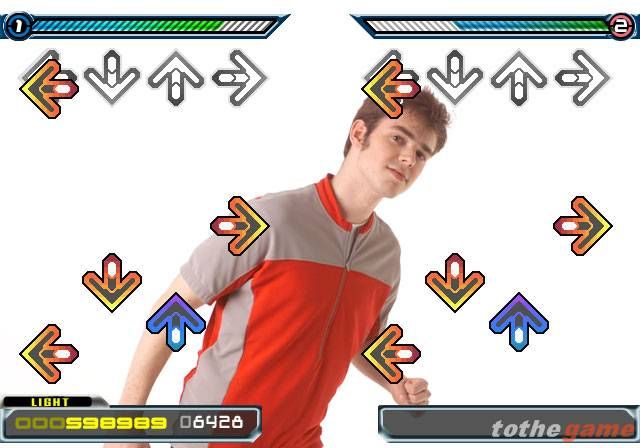
- Dancing Stage Max also makes use of Sony’s innovative Eye Toy? USB camera to put the player on screen or use particular images as backdrops to the action. It can also be used to play a Hands and’ Feet version of the game where you must use your hands as well as your feet!.Other bonuses include the ability to accrue points which can be used to buy new tracks, costumes for the on-screen dancers or even tips for prolonged play.
Dancing Stage Max is Konami’s European PlayStation 2 entry in the Dance Dance Revolution series. It is commonly described as the PAL counterpart to North America’s Dance Dance Revolution Extreme 2, but the two releases are not identical. Dancing Stage Max used the same broad structure and introduced the same Dance Master focus, while changing the licensed soundtrack and dropping the American version’s online play. Its proper UK release was on Friday, 25 November 2005, not 25 December 2002. The latter date belongs to the Japanese arcade release of Dance Dance Revolution Extreme.
What it is
This is a timing-based dance game built around a four-panel dance mat. Arrows travel towards a target at the top of the screen, and the player must step on the matching direction at the correct moment. Accuracy raises the dance gauge and builds the score; missed steps reduce it, with too many mistakes causing a failure. A DualShock 2 controller could be used, but the game was clearly designed for a dance mat, and playing with the pad removes much of the physical appeal.
There is no story or campaign in the conventional sense. Its setting is the brightly coloured, club-influenced presentation familiar from Dance Dance Revolution, with selectable dancers, animated backgrounds and music videos or visual sequences behind the scrolling arrows. The PAL release supported one or two players locally and was designed as both a solo rhythm challenge and a party game.
How it played
The principal single-player addition was Dance Master Mode. Rather than simply playing a fixed run of songs, the player worked through a branching set of challenges with conditions such as reaching a target score, achieving a required number of accurate steps, maintaining a combo or avoiding particular arrows. Completing challenges opened further routes, songs and rewards, giving the PAL game more structure than the traditional Free Play approach.
Free Play remained available for practising individual songs, while Advanced Mode gradually opened Course, Endless, Survival and Combo Challenge variants. Workout Mode tracked calories burned and recorded progress to a PlayStation 2 memory card. The game also supported Konami’s Edit functionality, allowing players to create or adjust step patterns. EyeToy compatibility added camera-based extras, including the Hands and Feet style of play and the option to place the player’s image into the presentation. An EyeToy camera was optional, not required.
Music and modes
Dancing Stage Max contained approximately 60 songs, including 20 licensed tracks and a substantial selection of Konami originals and returning Dance Dance Revolution material. Its licensed music was deliberately more European and pop-oriented than the Japanese releases. The selection included Natasha Bedingfield’s These Words, Franz Ferdinand’s Michael, Sugababes’ In the Middle, Mylo’s Drop the Pressure, Fatboy Slim’s Wonderful Night, Armand Van Helden’s My My My, Steps’ Chain Reaction, Adam and the Ants’ Goody Two Shoes, Hot Chocolate’s You Sexy Thing and Lulu’s Shout.
That soundtrack was one of the game’s defining strengths for British players, particularly when compared with the more arcade-focused Japanese versions. It was also a product of its period: familiar chart pop sat alongside older cover versions and Konami’s faster, more technical dance tracks. Songs and extras were not all available immediately, so completion-minded players had to spend time in Dance Master Mode and the in-game shop before the full selection became useful.
Reception
The UK Official PlayStation 2 Magazine awarded Dancing Stage Max 7/10. Its verdict was that Konami had not reinvented the formula, but that the underlying game remained enjoyable for players prepared to use a dance mat. The review’s score reflected the familiar criticism of the series: the basic play was dependable, but the presentation and structure offered limited change for anyone who already owned several Dancing Stage or Dance Dance Revolution releases.
A Swedish Gamereactor review gave the game 6/10, praising some of the more enjoyable songs while objecting to the amount of unlocking required before reaching the stronger material. GameSpot’s 7.2/10 review of the closely related North American Dance Dance Revolution Extreme 2 reached a similar conclusion: the rhythm mechanics remained sound, but the sequel was not sufficiently different to justify replacing an earlier PS2 edition for casual owners. That review also discussed online play, but its comments apply to the American release, not the PAL Dancing Stage Max disc.
Versions and legacy
The regional naming is important. Dancing Stage Max was not simply Dance Dance Revolution Extreme 2 with a different title. The North American game launched on 27 September 2005, included 74 songs and supported online multiplayer through the PlayStation 2 Network Adaptor. The PAL game launched earlier in Europe on 25 November 2005, used its own 60-song selection and had no online mode. The European release was also a console-only version rather than a PAL arcade conversion.
Today, Dancing Stage Max is remembered as one of the stronger European PS2 Dancing Stage soundtracks, even though its licensing choices are subjective and its unlock structure can feel slow. It remains an attractive archival release because it preserves a very specific British and European mid-2000s pop context. A PAL PS2, a compatible dance mat and a memory card provide the intended experience; the standard controller is functional, but it is best treated as a fallback.
Screenshots (01 Aug-2005)
Videos
Frequently asked questions
Is Dancing Stage Max the same game as Dance Dance Revolution Extreme 2?
It is the European counterpart, not an identical port. The structure and Dance Master Mode are closely related, but the PAL soundtrack, song count and network features differ.
Did Dancing Stage Max have online multiplayer?
No. The PAL Dancing Stage Max release was offline-only. The North American Dance Dance Revolution Extreme 2 is the version associated with PlayStation 2 online multiplayer, which is why some databases give the wrong answer for Max.
Will Dancing Stage Max work on a modern PlayStation?
It runs directly on a PAL PlayStation 2. Sony’s current PS5 backwards compatibility covers PS4 software rather than original PS2 discs; some early PS3 models could play PS2 discs, but compatibility depends on the exact model and region.
How can I play it now?
The most straightforward option is a second-hand PAL PS2, a PS2 memory card and a compatible dance mat. A DualShock 2 works for the menus and gameplay, but the game is much better with a mat; an EyeToy camera is optional for its camera features.
Is Dancing Stage Max rare?
The standard game is not generally regarded as an exceptionally rare PS2 release, although complete copies, boxed dance-mat bundles and clean cases can be less common. Prices vary considerably with condition and seller.