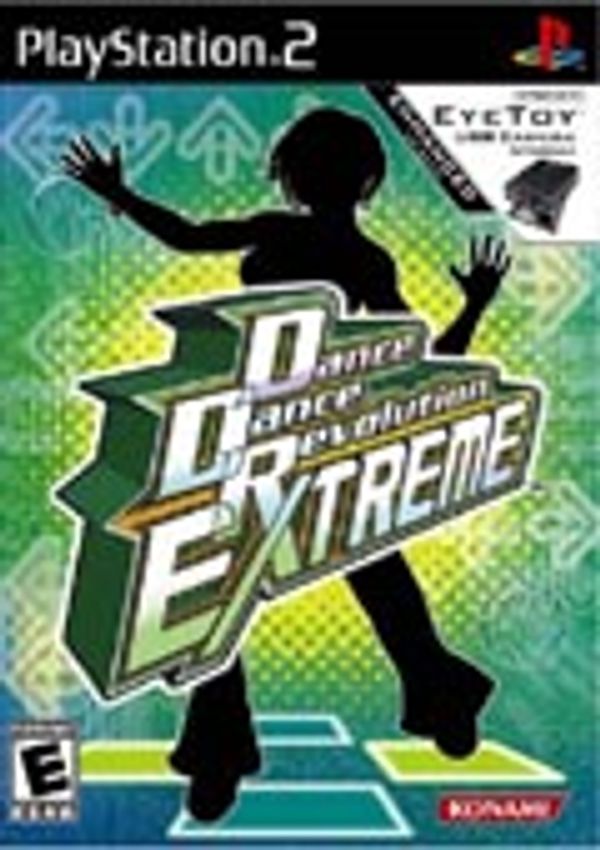
Dancing Stage Fusion (Aka Dance Dance Revolution Extreme)
About Dancing Stage Fusion (Aka Dance Dance Revolution Extreme)
From the archive
This is the original PS2Home fact sheet for Dancing Stage Fusion (Aka Dance Dance Revolution Extreme), preserved from the early-2000s archive. Details reflect the PAL release as catalogued at the time.
Official fact sheet
Konami hasn’t stopped dancing yet! With Dancing Stage Fusion you’ll be cutting a rug to SugarHill Gang fave ‘Rapper’s Delight’, Jamelia’s ‘Superstar’, Kylie anthem ‘Promises’, and lots more famous, not to mention famously danceable mega-hits. Fusion is a fabulous blend of dance classics past and present, to make you want to groove long into the future.
And if you want to see just how cool you look while dancing, Fusion allows you to hook up Sony’s EyeToy to put you center stage – right there, on your TV! So no matter how tough the game gets, with EyeToy you’ll want to make every challenge an award-winning performance! Or, if you want a break from your own dazzling moves, you can watch one of the cool licensed music videos instead.
Dancing Stage Fusion is the latest of Konami’s revolutionary videogames that get you playing literally on your toes, using a special dance mat. Millions of people enjoy Dancing Stage all over the world, so join the party and be ‘some kind of superstar’!
- Over 20 licensed tracks from world-famous pop stars
- See yourself dancing, on the TV using EyeToy
- Enjoy watching pop videos while you dance
Dancing Stage Fusion was Konami’s 2004 European PlayStation 2 entry in the Dance Dance Revolution family. It was released in the UK on 5 November 2004, not on Christmas Day 2002, and it was not simply a European rename of the Japanese PlayStation 2 version of Dance Dance Revolution Extreme. Fusion had its own 54-song PAL soundtrack, built around contemporary UK and European pop licences alongside Konami’s original dance music. The title is sometimes described as the European equivalent of Dance Dance Revolution Extreme because the regional games occupy a similar place in the PS2 series and share much of their presentation. That shorthand is useful, but the games are substantially different in their music and regional content. For a British player, Fusion was the third Dancing Stage game on PS2, following Dancing Stage MegaMix and Dancing Stage Fever.
What it was
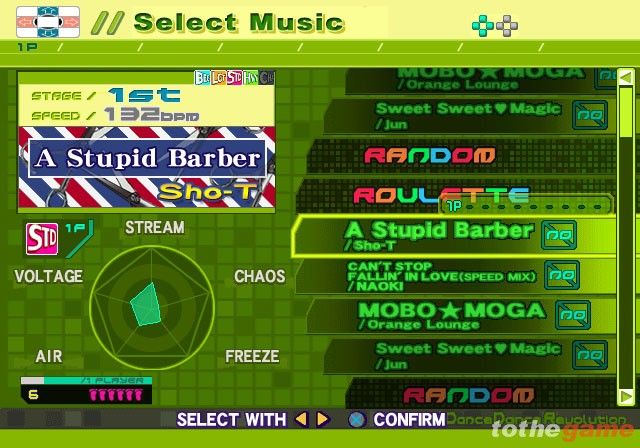
Fusion was a music and exercise game designed for a PlayStation 2 dance mat. Arrows travelled towards a target zone, and the player had to step on the matching directions in time with the beat. Accurate timing built the score and dance gauge; too many missed steps ended the performance. It supported one or two local players, with each participant able to select a different difficulty, making it workable for mixed-ability parties.
The central Game Mode could be played competitively or cooperatively, while Workout Mode tracked exercise and calories, Endless Mode allowed uninterrupted dancing, and Mission Mode added structured challenges for solo players. There were also Nonstop and Challenge courses, Edit Mode for creating routines, Double Mode for one player using two mats, and Party Games designed around the dance mat and optional EyeToy camera.
Music and presentation
The PS2 version contained 54 songs: 21 licensed tracks and 33 Konami compositions. Its licensed selection was unusually recognisable for a PAL Dancing Stage release, including Electric Six’s Danger! High Voltage, Moloko’s Familiar Feeling, Sugababes’ Freak Like Me, Kylie Minogue’s Come Into My World and Promises, Kim Wilde’s Kids in America, Pet Shop Boys’ Go West, Junior Senior’s Move Your Feet, Jamelia’s Superstar, The Darkness’ I Believe in a Thing Called Love and DJ Bobo’s Chihuahua 2002. Some tracks were covers or specially licensed versions rather than the original recordings.
Fusion’s most visible PS2-specific novelty was EyeToy support. The camera could be used in selected activities and mini-games, including modes that asked the player to move their arms while continuing to step. It was an amusing party extra rather than a replacement for the core dance-mat game, and contemporary criticism noted that the EyeToy features were not integrated throughout the main experience.
Versions and differences
The UK PS2 release was a PAL disc published in Europe by Konami’s European operation. A separate PlayStation version was released at the same time, but it was considerably smaller, with only 20 songs compared with the PS2 edition’s 54. The PS2 game was therefore the substantial home version for British players.
Fusion should not be confused with the Japanese PlayStation 2 Dance Dance Revolution Extreme. That Japanese release contained 111 songs, while the North American game carrying the Extreme name contained 71. Fusion used a different PAL song selection, replacing the American mix’s licences with tracks chosen for the European market. The shared series identity explains the frequent comparison, but the discs are not interchangeable versions of the same soundtrack.
Reception
The response was broadly positive but qualified. VideoGamer awarded Fusion 7/10 in February 2005, praising the larger single-player structure, Mission Mode, mini-games and workout value. It called the game an improvement and possibly the best Dancing Stage entry to that point, while criticising the opaque unlock system, uneven music selection and the sense that EyeToy support was an afterthought.
The criticism reflected the game’s position in the series. Fusion was still excellent at what Dancing Stage already did well: quick-to-understand rhythm play, local competition and noisy living-room entertainment. It did not radically change the formula, but it offered more content than Fever and made a stronger attempt to give solo players a reason to keep playing beyond simply repeating songs.
Legacy
Today, Fusion is best remembered as a distinctly European PAL Dancing Stage release rather than as an Extreme conversion. Its soundtrack preserves a particular 2004 moment, mixing chart pop, revival tracks and Konami’s more demanding electronic material. The game remains a good snapshot of the period when dance mats were both party peripherals and an early form of home fitness hardware.
It is not generally treated as a highly valuable PS2 rarity. Copies appear regularly on the second-hand market, although complete condition, the manual and the availability of a usable dance mat affect the practical cost more than the disc itself. For an authentic British setup, a PAL PS2, a compatible PS2 dance mat and, if desired, an EyeToy camera remain the straightforward solution.
Screenshots (01 Jan-2005)
Videos
Frequently asked questions
Is Dancing Stage Fusion the same game as Dance Dance Revolution Extreme?
No. It is a separate European release with a different 54-song soundtrack. The Japanese PS2 Dance Dance Revolution Extreme contains 111 songs, while the North American Extreme contains 71.
Can I play the PAL game on a modern PlayStation?
The dependable option is an original PAL PlayStation 2. Some early PlayStation 3 models supported PS2 discs, but compatibility depended on the model and region; PlayStation 5 backward compatibility officially covers PS4 games, not original PS2 discs.
Is Dancing Stage Fusion rare or expensive?
It is not generally regarded as a major PS2 rarity. Used PAL copies are commonly seen, although complete copies and suitable dance mats can cost more than a loose disc.
What do I need to play it properly today?
Use a PAL PS2 with a compatible dance mat. The EyeToy activities are optional, so the camera is not needed for the main rhythm game.